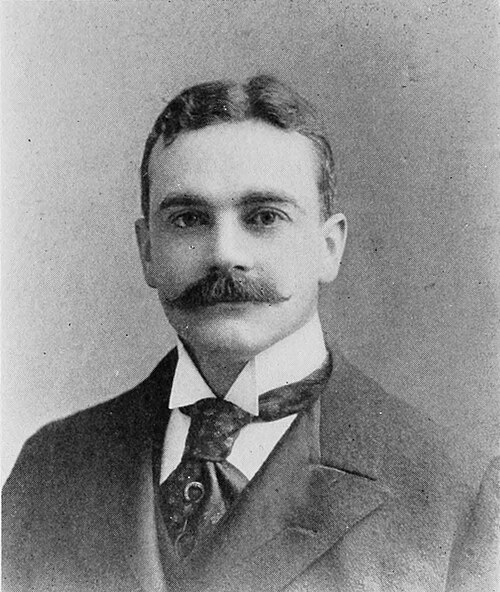
 Charles Allen Munn (May 22, 1859 – April 3, 1924) was a prominent American editor, publisher, and patron of the arts who played a significant role in the history of
Scientific American.
Charles Allen Munn (May 22, 1859 – April 3, 1924) was a prominent American editor, publisher, and patron of the arts who played a significant role in the history of
Scientific American.Queer Places:
Princeton University (Ivy League), 110 West College, Princeton, NJ 08544
62 E 65th St, New York, NY 10065, USA
Woodlawn Cemetery, 3800 Jerome Ave, Bronx, NY 10467, United States
Charles Allen Munn (May 22, 1859 – April 3, 1924) was a prominent American editor, publisher, and patron of the arts who played a significant role in the history of
Scientific American.
Born in Manhattan on May 22, 1859, to Orson Desaix Munn and Julia Augusta Allen, he descended from a long line of American ancestors, including Reuben Munn, who served during the American Revolution. After receiving his early education in New York and Paris, Munn attended Princeton University, graduating with an A.B. degree in 1881. Seeking to bolster his editorial capabilities, particularly regarding the magazine's extensive patent department, he subsequently earned a law degree at the New York Law School and was admitted to the bar.
Munn joined the publishing firm Munn & Co. in 1881, the same company his father had co-founded in 1846 alongside Alfred Ely Beach. He devoted forty-three years of his life to the organization, assuming leadership upon his father’s death in 1907. Under his presidency, he oversaw significant shifts in the publication’s strategy, most notably in November 1921, when he transitioned Scientific American from a weekly to a monthly magazine. Throughout his life, he remained a highly active member of New York's elite social and intellectual circles, holding memberships in numerous prestigious institutions including the Knickerbocker, Union, University, Century, Grolier, and Merchants' clubs. He was also elected a member of the Horace Walpole Society in 1915, a group dedicated to the study of the arts.
Beyond his professional life, Munn was a dedicated sportsman and a distinguished collector of Americana. He was an enthusiastic player of polo, golf, tennis, and racquets, and helped found the Essex County Country Club, where he served as captain of the polo team. His most enduring legacy, however, was his comprehensive collection of historical artifacts. He possessed a profound interest in early American history, specifically focusing on George Washington. His collection included invaluable items such as portraits by Gilbert Stuart, Trumbull, and Peale, as well as cameos, mezzotints, miniatures, diaries, and letters belonging to Washington, Benjamin Franklin, and other foundational figures. Upon his death, he bequeathed this significant collection to the Metropolitan Museum of Art.
Munn's final years were affected by declining health. While on a fishing trip in Scotland during the summer of 1923, he suffered a paralytic stroke. Despite this, he continued to work until shortly before his passing. Charles Allen Munn died at his home at 62 East Sixty-fifth Street in Manhattan on April 3, 1924, at the age of sixty-four. He was buried at Woodlawn Cemetery in the Bronx. He was succeeded as president of Munn & Co. by his nephew, Orson D. Munn.
References:
Support this project
This website is a passion project researched, developed, and funded entirely by me. If you find the content valuable and would like to help support the ongoing research and hosting costs, any contribution is deeply appreciated.
Thank you for keeping this independent resource alive!
My books on Amazon: Elisa Rolle's books